
—
Artificial intelligence isn’t coming to real estate someday. It’s already here, and the entrepreneurs learning how to use it effectively are building a serious competitive advantage.
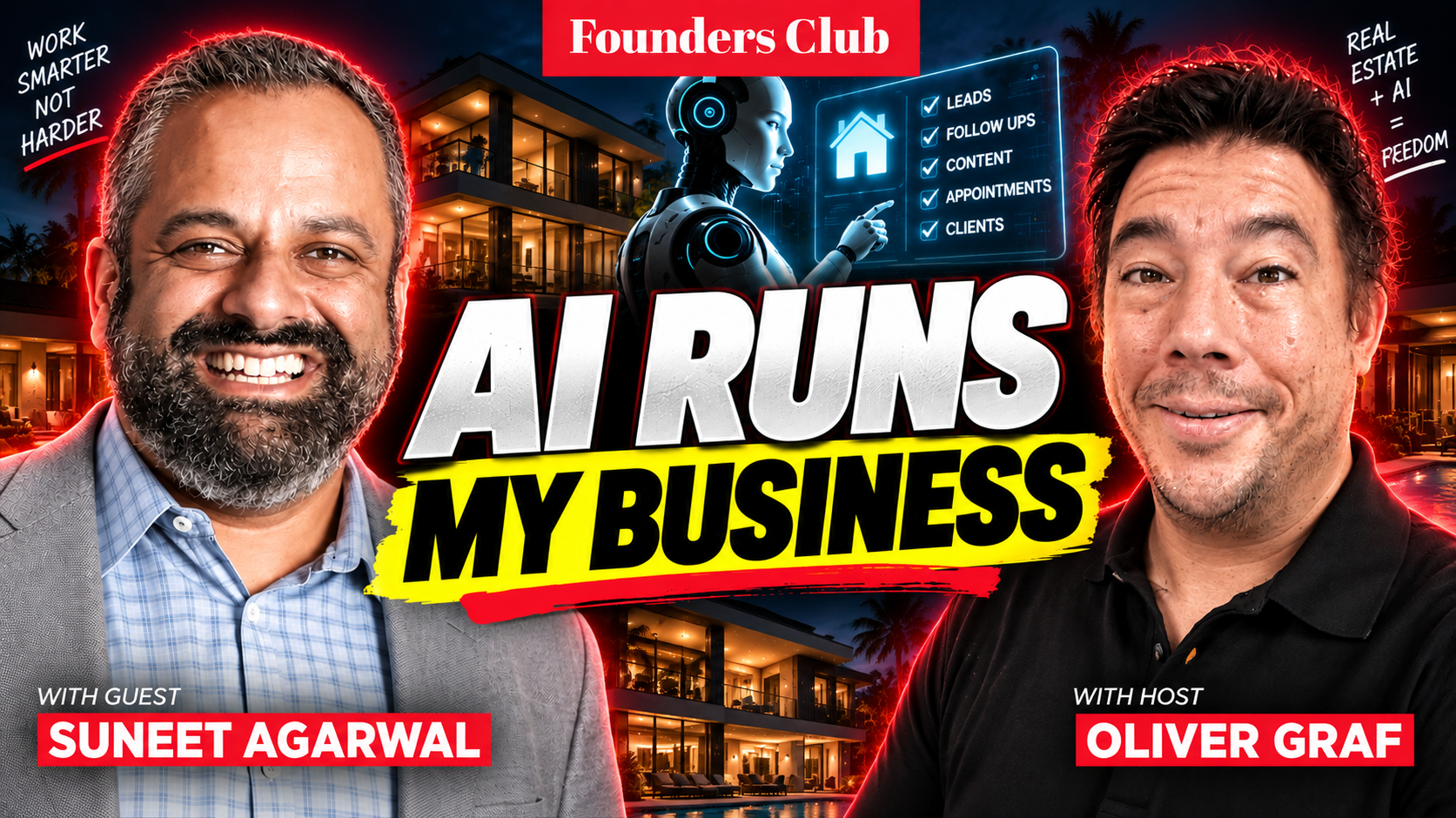
On this episode of Founders Club, I sat down with real estate entrepreneur, team leader, and author Suneet Agarwal to talk about how he’s actually using AI inside his businesses. And we went way beyond using ChatGPT to write emails or social media posts.
Suneet is building specialized AI agents, automating repetitive work, analyzing marketing data, identifying opportunities inside his CRM, and creating what he calls an “AI brain” that gives his systems context about his businesses and how he operates.
Whether you’re a real estate agent, investor, entrepreneur, or business owner, there are some major lessons here.
Episode summary: Suneet’s playbook centers on three jobs: give AI reliable business context, assign it a specific workflow, and keep people responsible for consequential decisions. Start with one recurring task—such as a morning briefing, meeting follow-up, or CRM review—before expanding the system. The tools and performance figures below reflect what Suneet described in this interview, not independently verified benchmarks or guaranteed results.
LISTEN TO THE FULL INTERVIEW HERE:
AI Is More Than ChatGPT
When most people hear AI, they still think about opening ChatGPT, asking a question, and getting an answer. That’s useful, but it’s only scratching the surface.
The bigger opportunity is moving from AI you talk to toward AI that actually works for you.
Instead of simply saying, “Write me an email,” imagine an AI system that understands your business, reviews information from multiple platforms, identifies what needs attention, and helps execute the next step.
Suneet has built specialized AI agents around different areas of his businesses. Some focus on social media, while others work with systems like Follow Up Boss, GoHighLevel, and Monday.com.
The key concept is simple: instead of asking one AI to do everything, build specialized AI workers around specific responsibilities.
That’s when AI starts becoming business infrastructure rather than another piece of software.
Start by Asking AI How It Can Help You
One of my favorite takeaways from the conversation was also one of the easiest things anybody can implement.
I constantly hear real estate agents and entrepreneurs say, “AI seems awesome, but I don’t know what I should use it for.”
Suneet’s answer is simple: ask AI.
Tell it what you do every day. Explain how you generate leads, communicate with customers, manage appointments, market your business, manage employees, and follow up with prospects.
Then tell AI to interview you about your business and ask: “Based on everything you know about my business, what could you automate or improve?”
You’ll probably find opportunities you hadn’t considered.
The goal isn’t to implement 100 AI systems tomorrow. Find one repetitive problem, solve it, and then move to the next one.
Build an AI Brain for Your Business
Anyone who uses AI regularly eventually runs into the same frustrating problem: context.
You spend time explaining your company, preferences, processes, writing style, goals, and strategies. Then you come back later and wonder why you’re explaining the same information again.
Suneet’s solution is creating an AI brain outside of any single AI model.
He initially experimented with systems including Notion and Monday.com and was working on moving more of that information into Obsidian. The specific software isn’t really the important part.
The big idea is creating a centralized source of truth about you and your business that AI can reference.
Your AI knowledge base could eventually include:
- Standard operating procedures and workflows
- Company goals and business strategies
- Brand voice and marketing guidelines
- Customer and sales information
- Meeting notes and important decisions
- Successful marketing campaigns
- Sales scripts and follow-up processes
- Lessons learned from previous projects
Think about how powerful AI becomes when you don’t have to explain your business from scratch every time you use it.
Imagine Starting Every Day Fully Briefed
One of the best real-world examples Suneet shared was his morning briefing system.
Every morning, he receives a Telegram message that organizes information about his upcoming day. The system looks at his calendar, notes, and relevant emails and gives him a play-by-play for his meetings.
Think about how most entrepreneurs start their mornings. You open your calendar, check email, search through messages, find your notes, and try to remember what happened during the last conversation with each person.
Suneet’s system brings that information together automatically so he can start the day already prepared.
That’s the difference between using AI as a search box and using AI as infrastructure.
For entrepreneurs, this is where the time savings start compounding. Saving 15 or 20 minutes on one task might not seem revolutionary, but saving that time across dozens of repetitive tasks every week can completely change how you operate.
Automate the Work That Happens After Meetings
Suneet also uses AI to process his consulting and coaching calls.
He keeps transcripts of his conversations and then uses AI to organize them into actionable information. The system can identify action items, prepare notes for the next conversation, draft follow-up emails, and identify issues that someone on his team may need to address.
Instead of a transcript sitting unused in a folder, the conversation becomes structured business intelligence.
This workflow had a very real impact on his organization. Suneet explained that he automated work previously handled by his VA/EA to the point where he no longer needed that role.
That doesn’t mean every entrepreneur should start replacing employees tomorrow. It means we should start asking a better question:
Which tasks actually require a human?
Your best people shouldn’t spend their days copying information between platforms, formatting notes, organizing data, or performing repetitive administrative tasks if technology can reliably handle that work.
AI Can Turn Marketing Into a Testing Machine
This was one of the parts of our conversation that really got my attention.
Suneet said his content generated 38 million views in one month. His approach to content is heavily based on testing, analyzing the results, and then creating more of what works.
AI allows you to do that at a completely different scale.
Instead of debating which hook might work, you can generate dozens of variations. Instead of guessing what type of content your audience wants, you can analyze the performance of everything you’ve already posted.
Suneet maintains data around previous content, including things like post types, hooks, timing, and performance. AI can analyze that information, give more weight to recent performance, identify patterns, and help create the next round of content based on what the audience has already proven it responds to.
He’s applying a similar approach to email marketing and said his email open rates were around 70% at the time of our conversation.
The lesson for entrepreneurs is huge: AI shouldn’t replace creativity. It should help make creativity more measurable.
Create something, test it, analyze the results, improve it, and repeat.
Your CRM Might Already Have Your Next Customers
Most businesses are obsessed with generating more leads. We spend money on advertising, content, cold outreach, funnels, SEO, and dozens of other strategies to get more people into the database.
But what if some of your best opportunities are already there?
Suneet described an AI workflow involving his GoHighLevel systems that looks for highly active prospects and people showing stronger buying signals. The system can compare information between databases, identify missing contacts, add them where appropriate, and notify his sales team when somebody deserves immediate attention.
You might not need another thousand leads. You might need a better system for identifying the 20 existing leads most likely to buy today.
For real estate agents, this could be massive. Our databases are filled with old internet leads, potential sellers, buyers, investors, past clients, referrals, and people who said they might be ready “in six months.”
AI can help turn all of that dormant information into something actionable.
A practical starting point: review CRM activity
- Inputs: Use the contact history and activity signals you are authorized to review. Keep the first test limited to a small, relevant set of records.
- AI output: Ask for a shortlist of contacts that may deserve attention, with the recorded activity supporting each suggestion. A signal is a reason to review, not proof that somebody will buy.
- Human review: Have a person check the source records, contact permissions, and proposed next step before outreach or database changes.
- Measure usefulness: Track review time, incorrect suggestions, and qualified conversations. This is a way to test the idea described above, not a claim that these steps reproduce Suneet’s results.
Automation Needs Guardrails
Of course, there’s another side to all this.
The more access you give AI, the more important security, permissions, and guardrails become.
Suneet talked about connecting AI into communication systems while still requiring explicit approval before certain messages can be sent. That’s an important distinction.
Automate aggressively, but don’t automate blindly.
Some smart principles for business owners include:
- Start with limited or read-only permissions
- Require human approval for sensitive actions
- Test automations before deploying them broadly
- Protect customer and company information
- Monitor AI usage and technology costs
- Create clear rules around what AI cannot do
- Keep humans involved in high-risk decisions
You want leverage, not chaos.
You Don’t Need to Become a Programmer
One of the most encouraging parts of this AI revolution is that entrepreneurs don’t necessarily need to become software engineers to benefit from it.
Suneet talked about using tools such as Claude Code and GitHub to accomplish things that previously would have required much deeper technical knowledge.
He also made an important point: sometimes you should stop trying to figure everything out yourself.
If you understand the outcome you want but implementation gets too technical, hire somebody who can bridge that gap. Your job as an entrepreneur isn’t necessarily to write every line of code.
Your job is to understand what technology makes possible and figure out how to apply it to your business.
Learn enough to identify opportunities and communicate what you want. Then leverage AI, employees, freelancers, developers, or other experts to execute.
The Biggest AI Risk Is Doing Nothing
One of Suneet’s strongest points was about the next generation of entrepreneurs entering the market.
There are young entrepreneurs who have been experimenting with generative AI since the beginning. They aren’t learning the traditional way of doing business first and then adding AI later.
They’re building AI into the business from day one.
That means established entrepreneurs aren’t only competing against the companies they know today. They’re going to compete against AI-native businesses designed to operate faster, leaner, and with significantly more automation.
You don’t have to chase every new AI platform. You don’t need 15 subscriptions, and you definitely don’t need to automate your entire company this weekend.
But doing nothing is becoming a business risk.
Five Things Entrepreneurs Can Do Right Now
If you want to take something actionable from this episode, start small. You don’t need Suneet’s entire AI stack on day one.
Here are five places I’d start:
- Have AI interview you about your business. Explain your responsibilities and ask it to identify repetitive tasks, bottlenecks, and automation opportunities.
- Create a centralized knowledge base. Organize your SOPs, strategies, meeting notes, brand guidelines, and company knowledge somewhere AI can eventually reference.
- Automate one repetitive workflow. Pick something you do every day or every week and determine how much manual work AI can eliminate.
- Analyze your existing marketing. Give AI your previous emails, social posts, hooks, campaigns, and performance data and ask it to identify patterns.
- Look inside your CRM before buying more leads. Identify existing prospects showing intent and create systems that help your salespeople follow up at the right time.
The goal isn’t to completely reinvent your business overnight. It’s to start building small advantages that compound.
The AI Advantage Is Compounding
The biggest thing I took away from my conversation with Suneet is that AI isn’t really about finding one killer application.
It’s about stacking small efficiencies across your entire organization.
Save time preparing for meetings. Automate follow-ups. Create more content. Improve your email performance. Identify better leads. Preserve institutional knowledge. Reduce repetitive administrative work. Give your team better information and respond to opportunities faster.
Each improvement might seem small by itself, but stack enough of them together and suddenly you’re operating a very different company.
The entrepreneurs who win with AI won’t necessarily be the people who know the most about artificial intelligence. They’ll be the people who get really good at applying it to actual business problems.
That’s exactly what Suneet Agarwal is doing, and this episode of Founders Club gives you an inside look at how these tools are already being used in a real-world real estate business.
Watch the full episode, pick one idea from the conversation, and start figuring out where AI can create leverage inside your business today.
Watch the full interview here: